Europe gathers strength
Europe has defied expectations of another bad year, while the US and China stumble.

You are now subscribed
Your newsletter sign-up was successful
Want to add more newsletters?

Twice daily
MoneyWeek
Get the latest financial news, insights and expert analysis from our award-winning MoneyWeek team, to help you understand what really matters when it comes to your finances.

Four times a week
Look After My Bills
Sign up to our free money-saving newsletter, filled with the latest news and expert advice to help you find the best tips and deals for managing your bills. Start saving today!
We heard a lot about "divergence" at the turn of the year. This was the idea that US growth would surge ahead, leaving other regions, especially Europe, standing. But it hasn't quite worked out like that, says Richard Barley in The Wall Street Journal. US data have been a little soft of late, while China has faltered too. Yet Europe is doing surprisingly well.
In March, activity in the manufacturing and services sectors hit its highest level in almost four years. First-quarter GDP growth looks set to come in at around 0.3%, says Markit's Chris Williamson, with 0.4% growth in Germany and 0.2% in France (an improvement after three years of stagnation).
MoneyWeek
Subscribe to MoneyWeek today and get your first six magazine issues absolutely FREE

Sign up to Money Morning
Don't miss the latest investment and personal finances news, market analysis, plus money-saving tips with our free twice-daily newsletter
Don't miss the latest investment and personal finances news, market analysis, plus money-saving tips with our free twice-daily newsletter
The credit squeeze is easing too, says the Buttonwood columnist in The Economist. Two widely watched measures of the money supply are growing by 4%-9%, a big improvement on a year ago. It seems banks may be working off their hangovers. Now that their balance sheets are stronger, they are more inclined to lend.
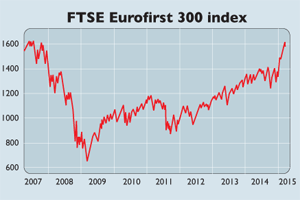
This gradual uptick actually pre-dated the European Central Bank's (ECB) quantitative easing (QE) scheme, says Christian Schulz of Berenberg, a German bank. "Much of what the ECB wanted to achieve with QE" falling bond yields, a weaker currency, and looser credit "happened before it started."
But QE has helped to buoy confidence and inflation expectations, which means there's more chance of avoiding a deflationary slump. And by hoovering up government bonds, the ECB has "insured" Europe against the threat of a Greek exit the yields on other highly indebted states' bonds have remained low.
This suggests that, even if Greece does leave the eurozone, then shares could keep rising. Recent history suggests that liquidity (availability of money) trumps fundamentals, and QE will continue until at least next year.The pan-European FTSE Eurofirst 300's multi-year rally isn't over yet.

-
 Average UK house price reaches £300,000 for first time, Halifax says
While the average house price has topped £300k, regional disparities still remain, Halifax finds.
-
 Barings Emerging Europe trust bounces back from Russia woes
Barings Emerging Europe trust has added the Middle East and Africa to its mandate, delivering a strong recovery, says Max King

