Join more than 165,000 subscribers and keep yourself informed with the latest financial news, insights and expert analysis to help you understand what really matters when it comes to your finances.
You are now subscribed
Your newsletter sign-up was successful
Want to add more newsletters?
An account already exists for this email address, please log in.
Stock markets: the profit-free rebound
The S&P 500 and FTSE 100 indices are at seven- and five-month high, as investors concentrate on economic recovery and cheap valuations. But by ignoring the earnings picture, there is plenty of scope for disappointment.
"The bulls are in control," says Vito Racinelli in Barron's. Optimism that the worst is over and growth could soon rebound has driven the S&P 500 and FTSE 100 indices to seven- and five-month highs respectively.
Because they have concentrated on economic recovery and cheap valuations of late, the earnings picture "has mattered little to investors", says Andrew Lapthorne of Socit Gnrale. Yet on this front there's ample room for disappointment, which investors can't ignore for much longer.
Globally, the slide in earnings-per-share expectations shows scant sign of abating, says Lapthorne. Downgrades to forecasts slowed this spring, but picked up speed again in May when analysts cut 6.3% off 2009 earnings estimates, compared with 3.9% the previous month. And there are still "plenty" of bullish forecasts that "require downward adjustment".
Start your trial of MoneyWeek today
Get unparalleled financial insight, analysis and expert opinion you can profit from.
Sign up for MoneyWeek’s free twice-daily newsletter.
Join more than 165,000 subscribers and keep yourself informed with latest financial news, insights and expert analysis to help you understand what really matters when it comes to your finances.
Join more than 165,000 subscribers and keep yourself informed with latest financial news, insights and expert analysis to help you understand what really matters when it comes to your finances.
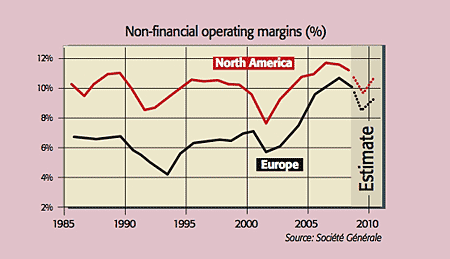
If you strip out the financial and energy sectors, where extreme losses and volatility distort the picture, US earnings growth is expected to trough in the third quarter before returning to growth in the fourth. Factor in anticipated sales and analysts are expecting margins to grow again from the fourth quarter. But these numbers are from "cloud cuckoo land".
The margin forecast implies only a slight dip from record highs and then a rebound, despite margins' tendency to revert to the mean and the unusually harsh recession in the US. It's hardly consistent with an environment of fast-rising unemployment and negative sales growth, says Lapthorne. So expect more downgrades ahead. Smithers & Co. point out that earnings will also be undermined by firms issuing shares to beef up their cash position. This will reverse the trend of recent years towards buybacks and dilute profits per share in the process.
Europe also looks set to struggle as further downgrades eventually return to centre stage. Robert Quinn of S&P thinks it unlikely that margins can expand before 2011, as unemployment is still rising this year. He also notes that the consensus still reckons profits can surge by an unrealistic 20% next year after a mere 13% drop in 2009. Stocks have raced ahead of the fundamentals, he says, and there seems little scope for further gains this year.
Sign up for MoneyWeek's newsletters
Join more than 165,000 subscribers and keep yourself informed with the latest financial news, insights and expert analysis to help you understand what really matters when it comes to your finances.
MoneyWeek is written by a team of experienced and award-winning journalists, plus expert columnists. As well as daily digital news and features, MoneyWeek also publishes a weekly magazine, covering investing and personal finance. From share tips, pensions, gold to practical investment tips - we provide a round-up to help you make money and keep it.