Join more than 165,000 subscribers and keep yourself informed with the latest financial news, insights and expert analysis to help you understand what really matters when it comes to your finances.
You are now subscribed
Your newsletter sign-up was successful
Want to add more newsletters?
An account already exists for this email address, please log in.
4G will boost this tech firm
With 4G soon to be rolled out in Britain, there's going to be a lot of testing of smartphones and transmitters, says Paul Hill. And that's where this tech stock come in.
After a powerful rally on the back of more money printing by the central banks, the valuations of many traditional safe-haven stocks (such as Nestl and Diageo) appear stretched. But one area in which there's still plenty of value is semiconductors. American-based Teradyne, which makes equipment for testing microchips for PCs, mobile phones and other computing applications, is a good example.
Last year, it acquired LitePoint Wireless for $580m, giving it direct exposure to the more profitable world of testing smartphones. As the latest handsets roll off assembly lines, customers such as Samsung now have even more tests to perform related to adding 4G transmitters and wi-fi capability, and this will create more demand for the firm's services.
Indeed, research firm IDC projects that in America alone, 4G adoption could soar by 87% a year through 2016, by which time there are expected to be 121 million subscribers across the country. This will create a gold mine for Teradyne, adding to the explosive growth the group has already enjoyed in the LitePoint division (20% of sales).
Start your trial of MoneyWeek today
Get unparalleled financial insight, analysis and expert opinion you can profit from.
Sign up for MoneyWeek’s free twice-daily newsletter.
Join more than 165,000 subscribers and keep yourself informed with latest financial news, insights and expert analysis to help you understand what really matters when it comes to your finances.
Join more than 165,000 subscribers and keep yourself informed with latest financial news, insights and expert analysis to help you understand what really matters when it comes to your finances.
Granted, the majority of the group is still tied to chip-testing for PCs and hard disk drives (67% sales), where of late growth has proceeded at snail's pace. However, this sluggishness will become far less important as sales ride the rushing tide of increased phone mobility.
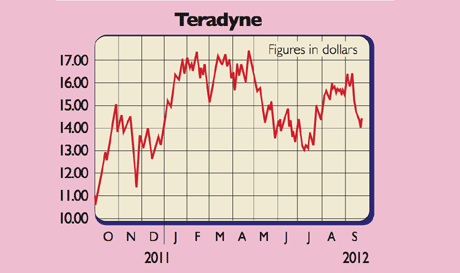
Teradyne (NYSE: TER), rated a BUY by Piper Jaffray
Wall Street is predicting revenues and earnings per share (EPS) of $1.75bn and $1.77 respectively, rising to $1.88bn and $2.01 in 2013. That puts the stock on a price/earnings (p/e) ratio of 8.2. I would rate the stock on a seven times earnings before interest, taxes, depreciation and amortisation (EBITDA) multiple. Adjusted for net cash of $660m, a $78m pension deficit and contingent consideration of $55m, this generates a fair value of $20 per share.
In the short term, if the Chinese economy slows significantly, or if there's a major wobble in Europe that delays the rollout of 4G wireless technology, the firm could hit trouble. There are also foreign currency considerations for British investors. But these dangers are more than priced into the downtrodden valuation.
Summing up after the release of the numbers of the first half year, CEO Mike Bradley commented: "LitePoint delivered record orders and revenue as customers continue to embrace its advantages in the fast-moving mobility market."
Moreover, with "increasing device complexity and new wireless standards" each requiring higher bandwidth and computing power the firm should see greater demand for test equipment in the years ahead. Piper Jaffray has a price target of $26 per share, while its third quarter results are expected in mid-October.
Rating: BUY at $14.40
Paul Hill also writes a weekly share-tipping newsletter, Precision Guided Investments. See www.moneyweek.com/PGI, or phone 020-7633 3634 for more information.
Explore More
Sign up for MoneyWeek's newsletters
Join more than 165,000 subscribers and keep yourself informed with the latest financial news, insights and expert analysis to help you understand what really matters when it comes to your finances.
Paul gained a degree in electrical engineering and went on to qualify as a chartered management accountant. He has extensive corporate finance and investment experience and is a member of the Securities Institute.
Over the past 16 years Paul has held top-level financial management and M&A roles for blue-chip companies such as O2, GKN and Unilever. He is now director of his own capital investment and consultancy firm, PMH Capital Limited.
Paul is an expert at analysing companies in new, fast-growing markets, and is an extremely shrewd stock-picker.