Join more than 165,000 subscribers and keep yourself informed with the latest financial news, insights and expert analysis to help you understand what really matters when it comes to your finances.
You are now subscribed
Your newsletter sign-up was successful
Want to add more newsletters?
An account already exists for this email address, please log in.
How JCDecaux became an unexpected winner of the AI boom
French company JCDecaux isn’t the most obvious AI play, but it offers valuable exposure to global audiences. Should investors buy in?
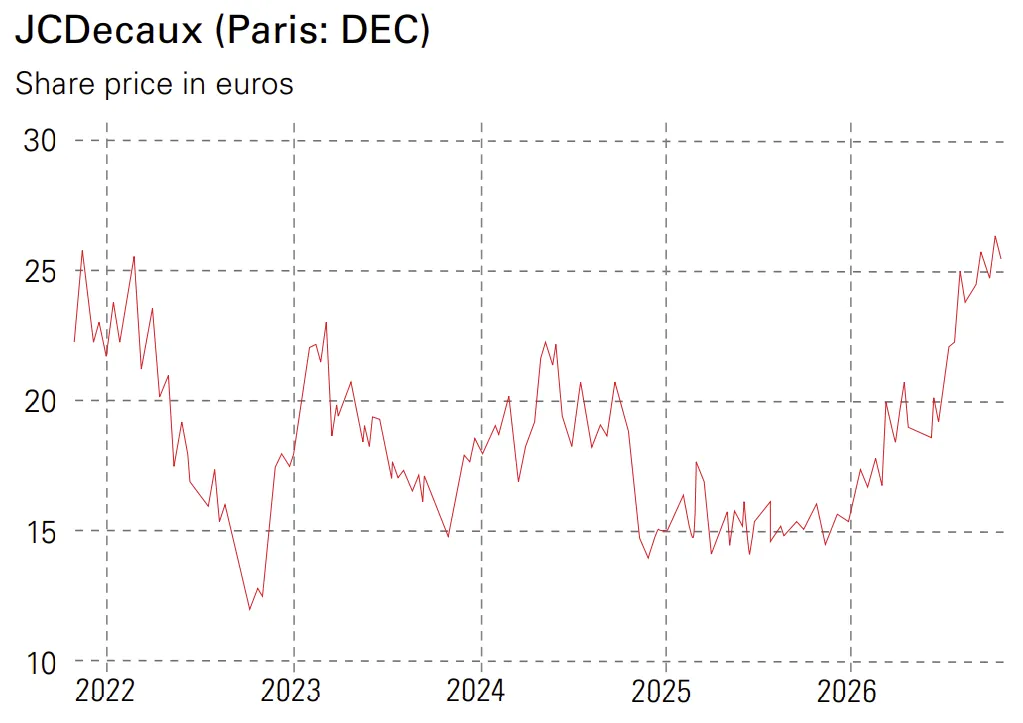
JCDecaux (Paris: DEC) has become an unexpected winner of the global AI boom. The company, which owns thousands of billboards and other advertising assets worldwide, isn't the most obvious AI play. But thanks to its vast real-world estate, it's reaping the benefits of a shift in spending by advertisers. As the market has woken up to this potential, the shares have charged higher, rising more than 70% this year alone.
Why JCDecaux's advertising strategy is a success
JCDecaux operates in the so-called out-of-home (OOH) advertising market. As I mentioned in a recent feature, this is one of the few traditional advertising mediums that have seen demand from advertisers rise over the past decade. According to WPP, one of the world's leading advertising companies, OOH advertising revenue is expected to grow 5% to $57.5 billion globally in 2026, then grow another 5.3% in 2027. By 2031, the group has pencilled in a total market size of $73.7 billion. WPP calls this growth a “structural anomaly”: while other traditional advertising mediums, such as radio, TV and print, are shrinking as a percentage of global spending, OOH is holding its own.
In the $720 billion-a-year global advertising market, digital platforms get the largest share of spending. Platforms such as Facebook and Google account for half the market. These are designed to get users to click through to websites and buy products or services. Alongside these are AI platforms, such as ChatGPT and Gemini, that have started embedding advertisements into responses, a market expected to exceed $100 billion by 2031, up from only $5 billion today.
Start your trial of MoneyWeek today
Get unparalleled financial insight, analysis and expert opinion you can profit from.
Sign up for MoneyWeek’s free twice-daily newsletter.
Join more than 165,000 subscribers and keep yourself informed with latest financial news, insights and expert analysis to help you understand what really matters when it comes to your finances.
Join more than 165,000 subscribers and keep yourself informed with latest financial news, insights and expert analysis to help you understand what really matters when it comes to your finances.
The thing is, no one really knows whether people are seeing the advertisements displayed on these platforms. Fraud is rife and more than half of all online traffic is now just AI bots. Estimates vary, but on average, figures suggest that as much as $1 of every $3 advertisers spend online is lost to fraud or non-human engagement. In some cases, that rises to $1.5 of every $3.
Advertising has always had some level of such “leakage”, but this level is unprecedented. OOH fills in this gap nicely. Advertisers can pick one location, say Bank Underground station in the City of London, and know they're in one place, with tens of thousands of people passing through every day. It's straightforward to target a particular audience in a given place with digital advertising, but there's never a guarantee that that person or digital device is where it says it is. It's hard to move a station, airport, or shopping centre, where the most lucrative OOH billboards tend to be located. Stadiums are another top play.
That's not to say OOH is winning at digital's expense. It's part of a toolkit. OOH is mainly used for visibility and brand building and helps drive awareness of the brand, increasing the likelihood you'll click a similar advertisement the next time you see it online. As analysts at Berenberg note, OOH enables the “critical need for brand differentiation as AI rapidly commoditises content”.
JCDecaux is a family success story
JCDecaux effectively created the market for outdoor advertising. In 1964, Jean-Claude Decaux invented the concept of “street furniture”, with bus shelters financed by advertising in Lyon (France). Two years later, it started rolling out the same concept across Europe. Since then, the business has grown alongside the advertising industry. It has worked with local governments, advertising agencies, clients, and world-leading designers, such as Norman Foster, to create street furniture and OOH advertisement placements that fit the environment, using space that would otherwise go unused.
Today, the founding Decaux family still owns a majority of the business (66% via JCDecaux Holding SAS) and it holds a 12% share of the global OOH market, making it the largest single player. France is still its largest single market with 17% of revenue generated in the country, followed by the UK (11%) and US (8%). The rest of Europe accounts for 30% of revenue, Asia-Pacific for 21% and the rest of the world 14%. Street furniture is the group's biggest revenue segment, making up just over 50% of sales and 66% of earnings before interest, tax, depreciation and amortisation (Ebitda).
Should you invest in JCDecaux?
(Image credit: Future)
Operating OOH assets is not particularly capital- or resource-intensive. The company has reported near 20% Ebitda margins for the past few years and Berenberg has pencilled in margin growth to 22.2% by 2028. While the group has some debt, it's manageable at 1.1x Ebitda. What's more, with free cash flow of €336 million in 2025, rising to €354 million by 2028, analysts believe the company is on track to wipe out its debt within the next three years.
However, that's unlikely as the group is hunting for deals in multiple markets, in the range of around €100 million – or around 50% of annual free cash flow after dividends. Even without these deals, Berenberg believes the group can grow its top line in line with the market over the coming years, with adjusted Ebitda rising faster – 6%-9% thanks to margin growth.
Even after running 70% higher this year, the shares trade at a relatively undemanding valuation of 17.1 times forward earnings and a free cash-flow yield of 6.6%. That does not appear to give any account for its growth or possible bolt-on deals. On Berenberg's 2028 estimates, JCDecaux is selling at 14.4 times earnings and a free cash-flow yield of 7.2%. The shares also yield 3%.
JCDecaux stands out for its rock-solid balance sheet, free cash flow and presence in a market that is full of AI-related risk, and seems to be holding its own against the digital onslaught.
This article was first published in MoneyWeek's magazine. Enjoy exclusive early access to news, opinion and analysis from our team of financial experts with a MoneyWeek subscription.
Explore More
Sign up for MoneyWeek's newsletters
Join more than 165,000 subscribers and keep yourself informed with the latest financial news, insights and expert analysis to help you understand what really matters when it comes to your finances.
Contributor and former deputy digital editor of MoneyWeek
Rupert is the former deputy digital editor of MoneyWeek. He's an active investor and has always been fascinated by the world of business and investing. His style has been heavily influenced by US investors Warren Buffett and Philip Carret. He is always looking for high-quality growth opportunities trading at a reasonable price, preferring cash generative businesses with strong balance sheets over blue-sky growth stocks.
Rupert has written for many UK and international publications including the Motley Fool, Gurufocus and ValueWalk, aimed at a range of readers; from the first timers to experienced high-net-worth individuals. Rupert has also founded and managed several businesses, including the New York-based hedge fund newsletter, Hidden Value Stocks. He has written over 20 ebooks and appeared as an expert commentator on the BBC World Service.