Join more than 165,000 subscribers and keep yourself informed with the latest financial news, insights and expert analysis to help you understand what really matters when it comes to your finances.
You are now subscribed
Your newsletter sign-up was successful
Want to add more newsletters?
An account already exists for this email address, please log in.
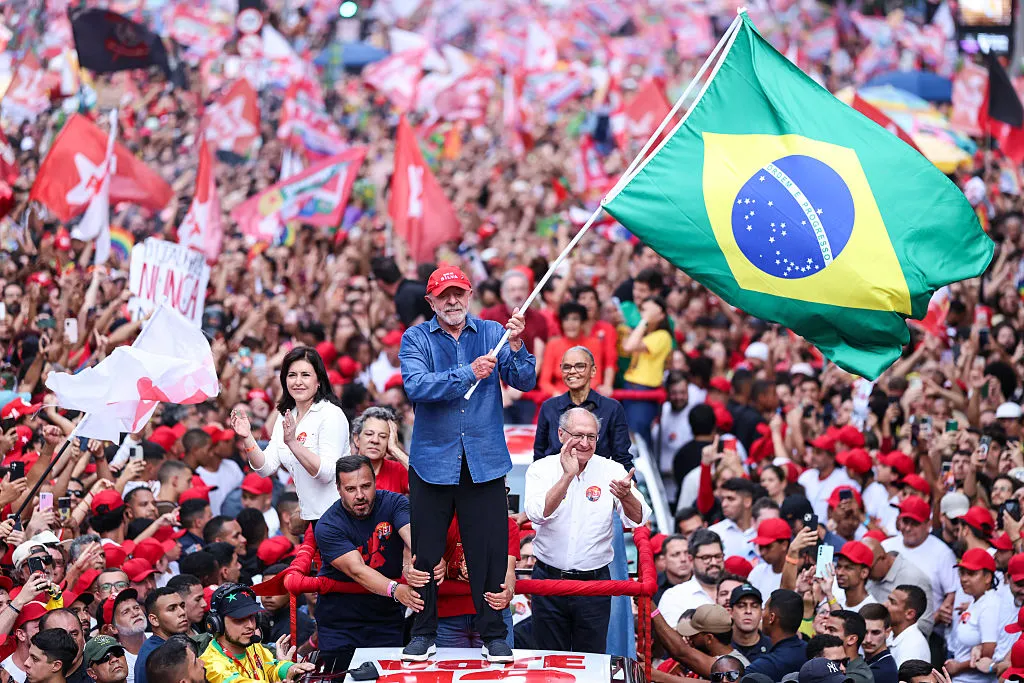
Brazilian stocks suffer ‘Black Monday’ as Lula wins
Brazilian stocks and currency suffered a “Black Monday” after the surprise re-election of Luiz Inácio Lula da Silva in the presidential elections
Brazilian stocks and its currency have suffered a “Black Monday” following the surprise re-election of Luiz Inacio Lula da Silva in the second round of presidential elections. The veteran left-winger's promise of a fiscal splurge is not going down well with investors, who sent the benchmark Ibovespa share index plunging nearly 14% on Monday, with the real currency selling off 8% against the dollar for its largest daily drop since 2002. That double-whammy sent the MSCI Brazil index, which is priced in dollars, down nearly 25%, a sell-off on the scale of the 1987 Black Monday crash on Wall Street, says John Authers on Bloomberg.
What does Lula's victory mean for Brazilian stocks?
Lula entered the second-round vote as the underdog after coming second in the first round behind Flavio Bolsonaro, his right-wing opponent. But polls always showed that the vote was close. The scale of the sell-off of Brazilian stocks says more about the political biases of stock and bond investors – who had priced in a 100% chance of victory for Bolsonaro – than it does about the scale of the electoral upset. Latin American markets have a persistent tendency to “freak out” whenever a left-winger wins, but this creates distortions and “buying opportunities” for the more dispassionate.
Lula's victory is “one of the most remarkable comebacks” in recent Brazilian history, says Viktor Szabo of Aberdeen Investments. Since the return to democracy in the 1980s, no candidate who trailed in the first-round has gone on to win in the second.
Start your trial of MoneyWeek today
Get unparalleled financial insight, analysis and expert opinion you can profit from.
Sign up for MoneyWeek’s free twice-daily newsletter.
Join more than 165,000 subscribers and keep yourself informed with latest financial news, insights and expert analysis to help you understand what really matters when it comes to your finances.
Join more than 165,000 subscribers and keep yourself informed with latest financial news, insights and expert analysis to help you understand what really matters when it comes to your finances.
The victory was bought at the cost of a raft of populist economic promises, including a 15% rise in family benefits, a federal fuel tax holiday, a new monthly stipend for low-income university students, free public transport at weekends and a reduction in the maximum working week from 44 to 40 hours with no fall in pay.
Brazil has little room to pay for it all. Gross public debt stands at 83% – a high level for an emerging economy – and the deficit is close to 10% of GDP. The country also pays “one of the highest real interest rates in the world”. Interest payments in Brazil “eat up” roughly 35% of all current government revenue, Thierry Larose of Vontobel Asset Management tells Barron's.
Still, history suggests that investors are overreacting, says Sebastian Pellejero on Breakingviews. Lula has a pragmatic streak and his record is impressive. The economy grew more than 4% a year during his first two terms in the 2000s. And the Ibovespa remains 57% higher since he returned to office in 2023, even following the latest sell-off.
Lula faces a right-leaning Congress that will block some of his spending plans. And in an era of commodity inflation, Brazil's vast energy and agricultural reserves are driving rising trade surpluses. “For all its problems, there's... always some sun in Brazil.”
This article was first published in MoneyWeek's magazine. Enjoy exclusive early access to news, opinion and analysis from our team of financial experts with a MoneyWeek subscription.
Sign up for MoneyWeek's newsletters
Join more than 165,000 subscribers and keep yourself informed with the latest financial news, insights and expert analysis to help you understand what really matters when it comes to your finances.
Alex is an investment writer who has been contributing to MoneyWeek since 2015. He has been the magazine’s markets editor since 2019.
Alex has a passion for demystifying the often arcane world of finance for a general readership. While financial media tends to focus compulsively on the latest trend, the best opportunities can lie forgotten elsewhere.
He is especially interested in European equities – where his fluent French helps him to cover the continent’s largest bourse – and emerging markets, where his experience living in Beijing, and conversational Chinese, prove useful.
Hailing from Leeds, he studied Philosophy, Politics and Economics at the University of Oxford. He also holds a Master of Public Health from the University of Manchester.