Get the latest financial news, insights and expert analysis from our award-winning MoneyWeek team, to help you understand what really matters when it comes to your finances.
You are now subscribed
Your newsletter sign-up was successful
Want to add more newsletters?
Twice daily
MoneyWeek
Get the latest financial news, insights and expert analysis from our award-winning MoneyWeek team, to help you understand what really matters when it comes to your finances.

Four times a week
Look After My Bills
Sign up to our free money-saving newsletter, filled with the latest news and expert advice to help you find the best tips and deals for managing your bills. Start saving today!
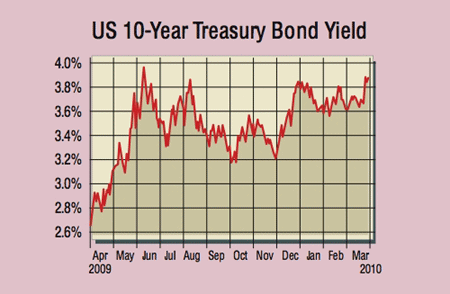
Are the markets losing patience with US government debt? Last week three US government bond auctions met with unexpectedly lacklustre demand. The yield on the ten-year Treasury jumped to a nine-month high of 3.9%.
In a further sign of market stress, the ten-year yield rose above the ten-year swap rate for the first time in living memory. The swap rate measures the cost of interbank borrowing. So this move implies the US government is a bigger credit risk than banks. The worry is that investors are now balking at the record debt sales needed to cover this year's deficit of $1.4trn and imposing a sustained rise in yields (via falling bond prices). In short, they want higher interest rates to compensate for the huge supply increases. The trouble is Treasury yields are the benchmark for interest rates across the economy. Higher yields will mean higher mortgage, credit card and corporate borrowing costs. That's a nasty cocktail that could choke off the anaemic recovery and hit equities.
But this could well be just a "short-term bout of jitters" that occasionally hits markets rather than the beginning of a "bloodbath" in US bonds, says Capital Economics. A disappointing German auction earlier this year raised similar concerns, but German yields have fallen back. A key trigger for last week's panic was the passage of the $940bn healthcare bill. This must have reignited concern over the scale of spending, says Richard Barley in The Wall Street Journal. But the healthcare fuss is hardly news. Technical factors also explain the bond sell-off. Speculators betting on the yield gap between Treasuries and swaps were probably caught out by the sudden market move and were forced to sell Treasuries to close out positions.
MoneyWeek
Subscribe to MoneyWeek today and get your first six magazine issues absolutely FREE
Sign up to Money Morning
Don't miss the latest investment and personal finances news, market analysis, plus money-saving tips with our free twice-daily newsletter

Meanwhile, it's hard to see bond markets turning their full attention to America, hitherto the world's safe haven. After all, there are still "plenty more strains in the eurozone to go through", says Steve Barrow of Standard Bank. "I will be astonished if countries such as the UK and US entirely avoid a government bond market shock; but I also suspect that this will occur some time down the road," agrees Gillian Tett in the FT. Whatever happens, says Barley, the markets will be keeping an unusually close eye on next week's US Treasury auctions.
Get the latest financial news, insights and expert analysis from our award-winning MoneyWeek team, to help you understand what really matters when it comes to your finances.
MoneyWeek is written by a team of experienced and award-winning journalists, plus expert columnists. As well as daily digital news and features, MoneyWeek also publishes a weekly magazine, covering investing and personal finance. From share tips, pensions, gold to practical investment tips - we provide a round-up to help you make money and keep it.
-
Average UK house price reaches £300,000 for first time, Halifax saysWhile the average house price has topped £300k, regional disparities still remain, Halifax finds.
-
Barings Emerging Europe trust bounces back from Russia woesBarings Emerging Europe trust has added the Middle East and Africa to its mandate, delivering a strong recovery, says Max King
