Join more than 165,000 subscribers and keep yourself informed with the latest financial news, insights and expert analysis to help you understand what really matters when it comes to your finances.
You are now subscribed
Your newsletter sign-up was successful
Want to add more newsletters?
An account already exists for this email address, please log in.
Is the bond bull market over?
Government bonds may be overpriced, but there's life in the bubble yet.
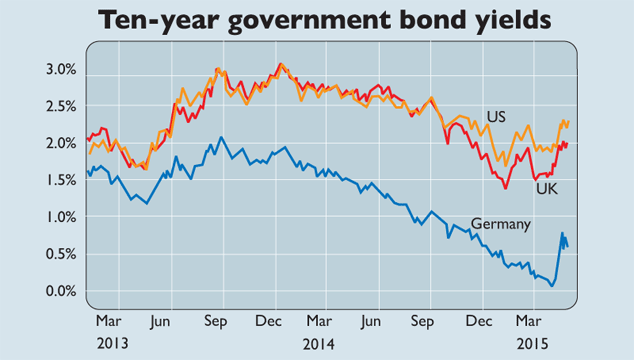
"We can all be caught up in the mood of the moment," says Capital Economics. "But talk of a rout' in the global bond markets is, at best, premature." The recent jump in ten-year UK, US and German bond yields reflecting falling prices looks "dramatic". The German ten-year bund yield soared from 0.07% in mid-April to a high of 0.8%; this week it has fallen to around 0.6%. But the moves were smaller than 2013's jump in yields the so-called taper tantrum.And that was ultimately reversed.
It's certainly too early to call the end of the bond bull market that began with the defeat of inflation in the early 1980s, agrees John Authers in the Financial Times. German yields are still lower than ever seen before December 2014. And the rise in yields may not continue.
The European Central Bank (ECB) may have convinced markets that it has done enough to avert deflation. But that's not the same as convincing them that the recovery is entrenched, which would imply higher yields (and so lower bond prices). Bund yields "still signal deep negativity" about Europe, says Authers. And the ECB is still hoovering up bonds with printed money.
Start your trial of MoneyWeek today
Get unparalleled financial insight, analysis and expert opinion you can profit from.
Sign up for MoneyWeek’s free twice-daily newsletter.
Join more than 165,000 subscribers and keep yourself informed with latest financial news, insights and expert analysis to help you understand what really matters when it comes to your finances.
Join more than 165,000 subscribers and keep yourself informed with latest financial news, insights and expert analysis to help you understand what really matters when it comes to your finances.
What could change the outlook? The US ultimately sets the tone for bonds. If it raises interest rates sooner than expected, or seems to be behind the inflation curve, yields could surge. But how long, as Ambrose Evans-Pritchard wonders inThe Daily Telegraph, could the world economy cope with a spike in yields before it "sets off a chain of nasty consequences, and ultimately defeats itself"?
Overall debt has hit a record 175% of GDP in emerging markets and 275% in developed ones. Emerging markets have racked up $4.5trn in dollar debt. That makes economies vulnerable to dearer US money. "There comes a point when [the interest-rate rise] is too fast and too vicious, and starts to hit earnings. That is when we could get an equity sell-off," says Andrew Roberts of RBS.
Corporate debt looks just as overpriced and as precarious as equities, whose boom "is already long in the tooth and reliant on record margin debt", says Evans-Pritchard. Turbulence would send investors back to bonds, and may even mean more quantitative easing. Yields would fall again. So while it's perfectly possible that we've seen the absolute peak of the multi-decade bond bull market, "don't bank on it".
Sign up for MoneyWeek's newsletters
Join more than 165,000 subscribers and keep yourself informed with the latest financial news, insights and expert analysis to help you understand what really matters when it comes to your finances.